Social learning platform analysis – Wikipedia
Platform Choice and Justification
I chose Wikipedia for my social learning platform analysis because I have always been curious about its role in education. Since starting university, I have often been told that Wikipedia is not a reliable academic source and should not be used as a reference in assignments. However, despite this reputation, Wikipedia remains one of the first places people turn to when searching for information. This contradiction interests me because I want to understand why Wikipedia continues to be such a widely used source of knowledge and whether its design supports meaningful learning beyond simply providing information.
Analytical Framework
To evaluate Wikipedia as a social learning platform, I developed a four-dimensional framework based on Bates’s (2015) SECTIONS model, CAST’s (2024) Universal Design for Learning (UDL) Guidelines, and Laurillard’s (2002) Conversational Framework. Together, these theories help examine how platform design supports access to information, independent exploration, and collaborative learning.
The framework evaluates four dimensions:
- Accessibility and Inclusion: Drawing on UDL and Bates’s considerations of students and ease of use, this dimension examines language options, information presentation, and potential accessibility barriers.
- Learner Agency and Active Exploration: Based on Laurillard’s interactive media and Bates’s teaching functions, this dimension assesses navigation, learner control, and opportunities for meaningful exploration.
- Social Interaction and Collaborative Learning: Drawing on Laurillard’s emphasis on dialogue and Bates’s interaction and networking considerations, this dimension examines discussion, collaborative editing, and barriers to participation.
- Credibility and Critical Evaluation: This dimension examines whether references and revision histories help learners question, verify, and critically evaluate information.
Each dimension is scored from 1 to 5 using observable evidence. A score of 1 indicates substantial barriers, 3 indicates meaningful support with significant limitations, and 5 indicates effective support with few barriers. Scores of 2 and 4 represent intermediate levels. This framework evaluates the learning opportunities Wikipedia provides while recognizing that the availability of a feature does not necessarily guarantee meaningful learning.
Platform Analysis
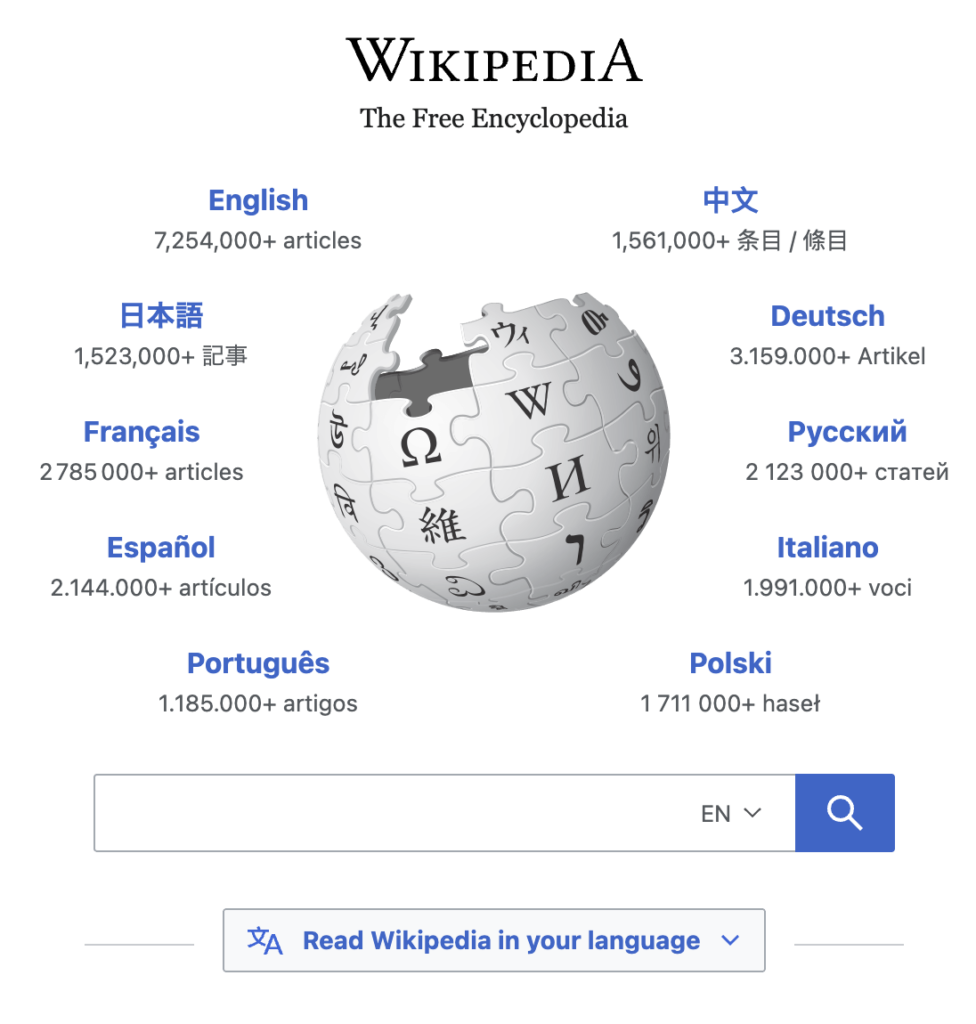
Figure 1
1. Accessibility and Inclusion – 4/5
Wikipedia provides access to information in multiple languages, allowing learners to explore topics in their preferred language (Figure 1). It also offers customizable reading settings, including text size, page width, and colour preferences. These features align with CAST’s (2024) Universal Design for Learning (UDL) Guidelines, particularly its emphasis on providing multiple means of representation to reduce learning barriers.
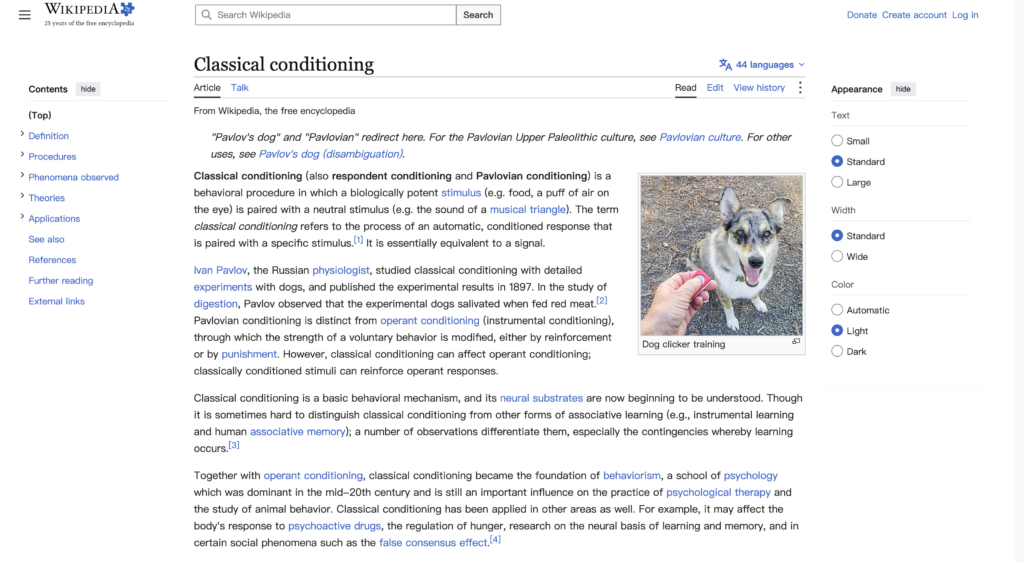
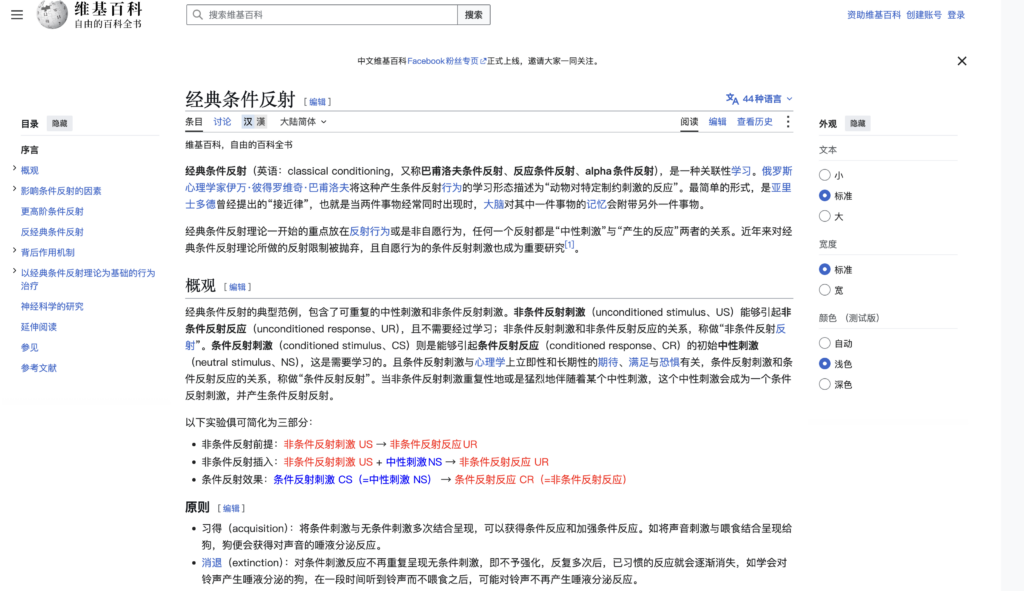
Figure 2
However, comparing the English and Chinese articles on classical conditioning (Figure 2) revealed differences in how the same concept is explained. The English article includes historical context and a photograph of dog training, while the Chinese article presents a more structured explanation of conditioned and unconditioned stimuli. These differences may support learners in different ways, depending on their prior knowledge and learning needs. Although Wikipedia offers considerable flexibility, multilingual access does not necessarily provide identical learning experiences. Therefore, I assigned 4/5, recognizing its strengths while acknowledging differences in information presentation and the limits of my accessibility observations.
2. Learner Agency and Knowledge Exploration – 4/5
Wikipedia supports independent exploration through hyperlinks, search functions, and organized article sections. For example, while reading about classical conditioning, I encountered a link to Pavlovian culture, which led me to an unrelated archaeological topic (Figure 3). This demonstrates how learners can move beyond their original search and discover additional information.
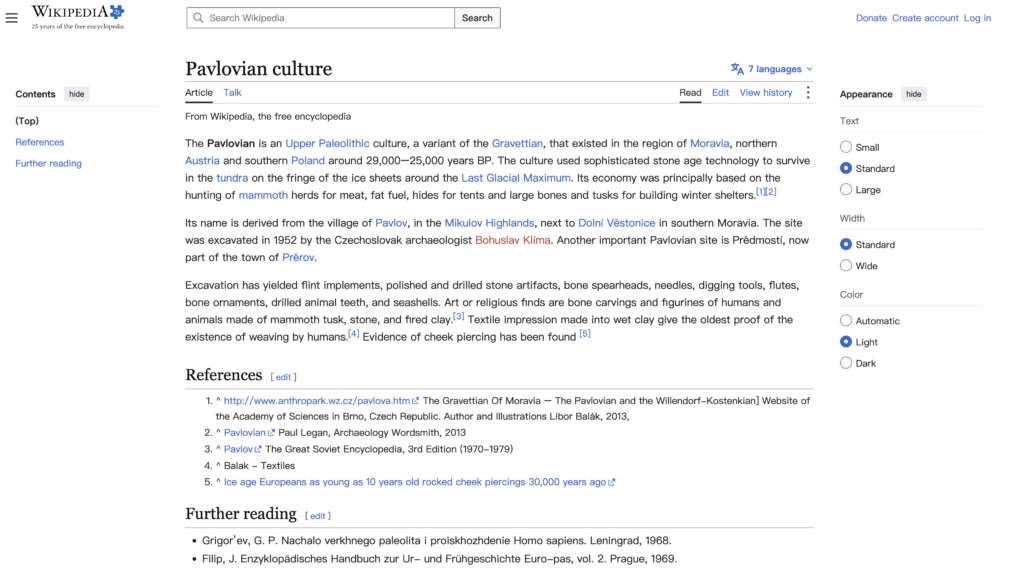
Figure 3
Laurillard’s (2002) discussion of interactive media highlights learners’ ability to navigate and select information, while Bates’s (2015) teaching functions encourage consideration of how technology supports learning activities. Although Wikipedia provides considerable freedom to explore, clicking through articles does not necessarily demonstrate meaningful learning. Its headings and contents menus help organize information, but learners must still determine which connections are relevant to their goals. I assigned 4/5 because Wikipedia supports learner autonomy and exploration, but provides limited structured opportunities to apply knowledge or check understanding.
3. Social Interaction and Collaborative Learning – 2/5
Wikipedia’s revision history shows that articles are continuously edited and maintained by different contributors (Figure 4). For example, the classical conditioning article includes corrections, formatting changes, and reversed edits. However, these records demonstrate collaborative content production rather than direct interaction between learners.
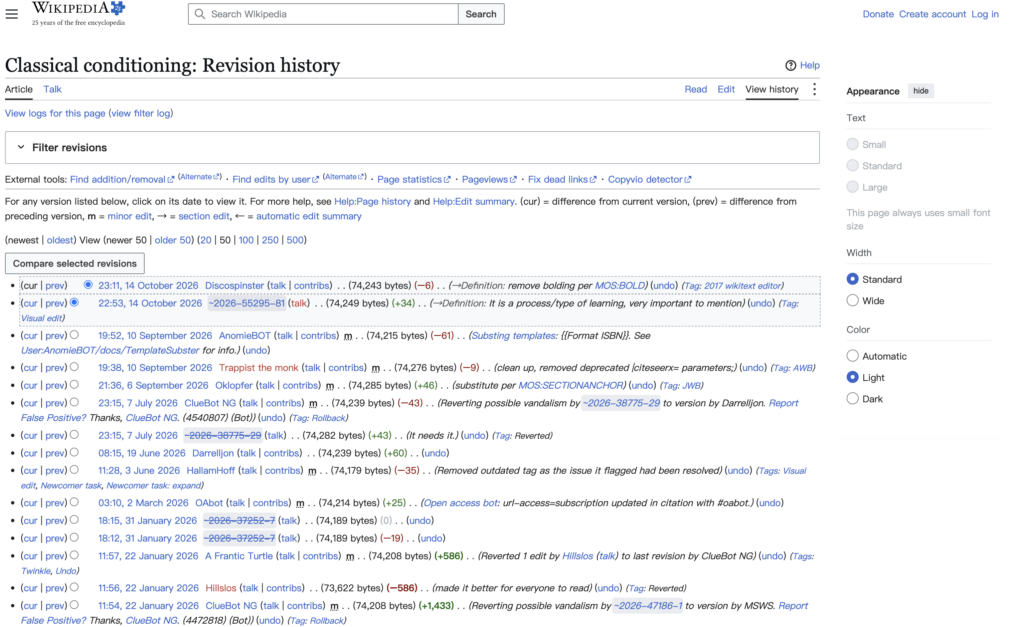
Figure 4
Although Wikipedia provides Talk pages for discussing article improvements (Figure 5), I found this feature difficult to navigate. The page initially presents community guidelines and article information rather than visible conversations, making it challenging for a newcomer to understand how to participate. This connects to Laurillard’s (2002) Conversational Framework, which emphasizes dialogue and feedback in supporting learning. While Wikipedia enables collaborative knowledge construction, these opportunities may be less accessible to inexperienced users. I assigned 2/5 because collaboration is clearly present, but the barriers I encountered limited my ability to engage in meaningful interaction.
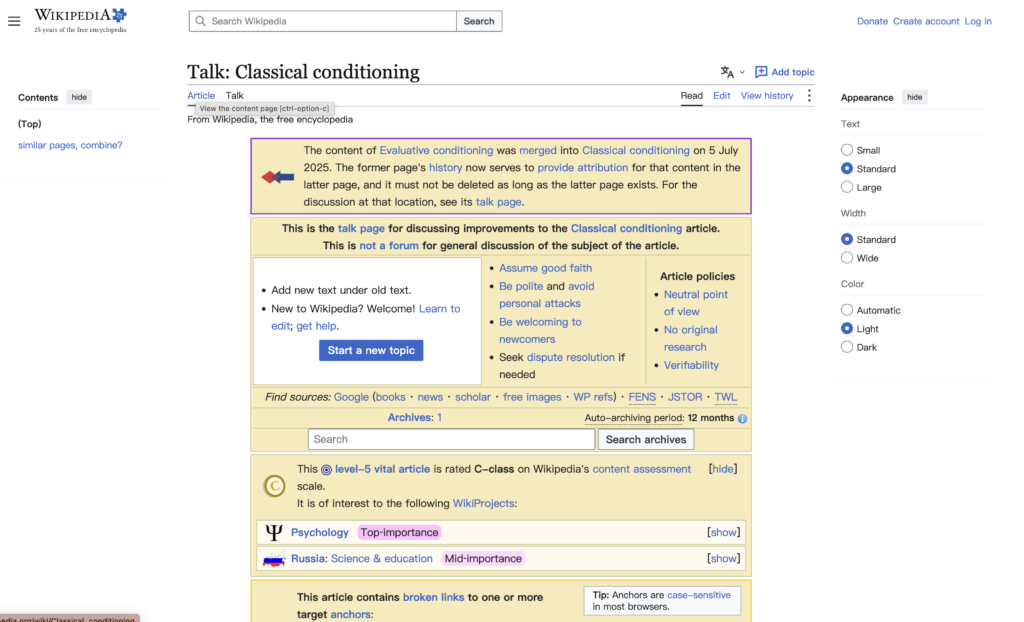
Figure 5
4. Credibility, Feedback, and Critical Evaluation – 4/5
Wikipedia provides references and revision histories that allow readers to examine where information comes from and how it changes over time. For example, the Classical conditioning article includes references to academic research, textbooks, and general informational websites (Figure 6). These sources provide opportunities for readers to verify information rather than simply accepting the article as accurate.
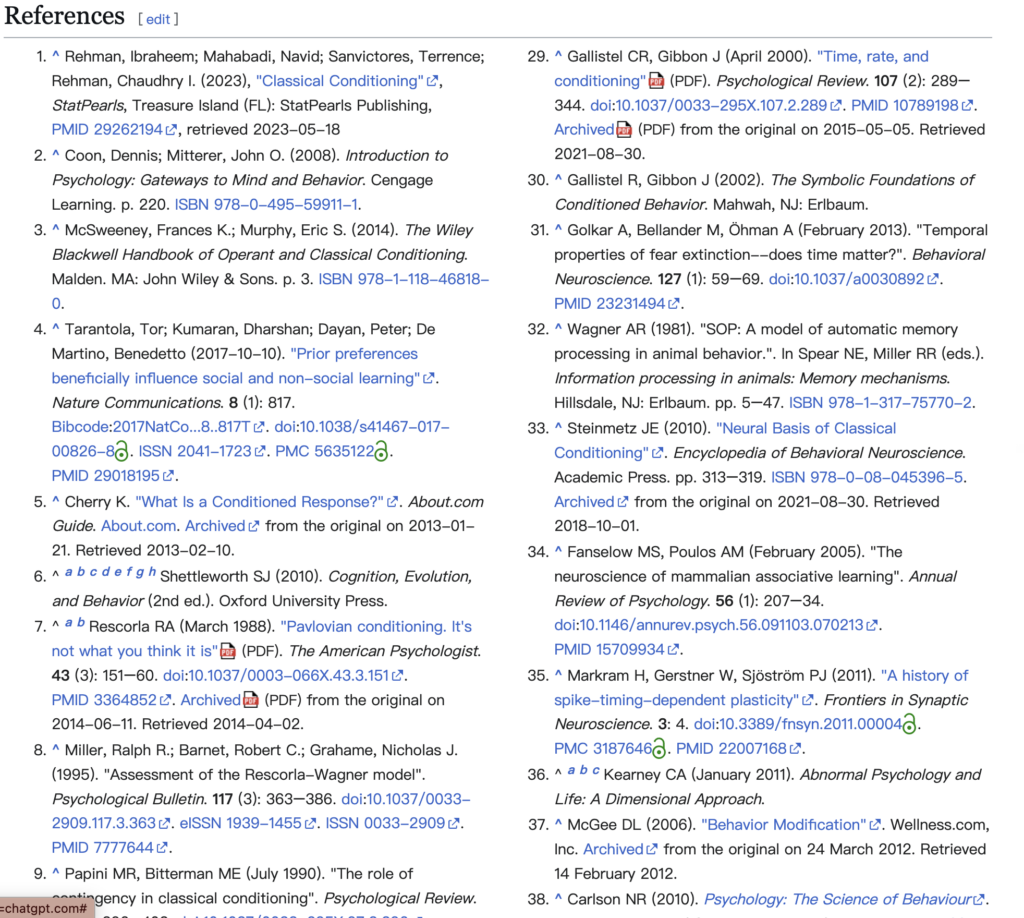
Figure 6
This connects to Bates’s (2015) consideration of teaching functions, particularly how technology supports learning activities. Wikipedia’s transparent referencing system can encourage critical evaluation, but the presence of citations does not guarantee their reliability. Readers must still determine whether sources are credible and relevant, which may be challenging for those without sufficient research or digital literacy skills. I assigned 4/5 because Wikipedia offers strong opportunities for verification, although it provides limited guidance for evaluating the quality of individual sources.
Overall Assessment — 14/20
Overall, Wikipedia demonstrates strong potential for independent learning through its accessibility, navigation, and transparent referencing system. However, its collaborative features may be less approachable for newcomers, suggesting that access to knowledge does not necessarily translate into meaningful participation in its creation.
Reflection and Implications
Before this analysis, I mainly viewed Wikipedia as a convenient source of information. Its organized articles and extensive references made it feel credible, even though I had often been discouraged from using it in academic assignments. However, evaluating its design helped me realize that having access to information is not the same as knowing how to use or evaluate it effectively.
What stood out to me most was the difference between reading and contributing to Wikipedia. Although anyone can explore its articles, I found the Talk page difficult to navigate. This made me question whether Wikipedia’s collaborative features are equally accessible to newcomers and experienced contributors. Those who understand its editing conventions may have greater influence over how knowledge is presented.
I also recognize that my assessment reflects my experience with a limited number of pages, rather than every learner’s experience. More broadly, this analysis suggests that learning platforms should not only provide access and freedom to explore but also make meaningful participation and critical evaluation easier for different learners.
References
Chapter 8: Choosing and using media in education: The SECTIONS model – teaching
in a digital age. (2015, April 5). Opentextbc.Ca. https://opentextbc.ca/teachinginadigitalage/part/9-pedagogical-differences-between-media/
CAST, Inc. (n.d.). The UDL guidelines. CAST Universal Design for Learning
Guidelines. https://udlguidelines.cast.org/
Laurillard, D. (2002). Rethinking university teaching : a conversational framework for
the effective use of learning technologies (2nd ed.). Taylor and Francis. https://doi.org/10.4324/9781315012940